
Premium German Timber Frame Homes
Introduction
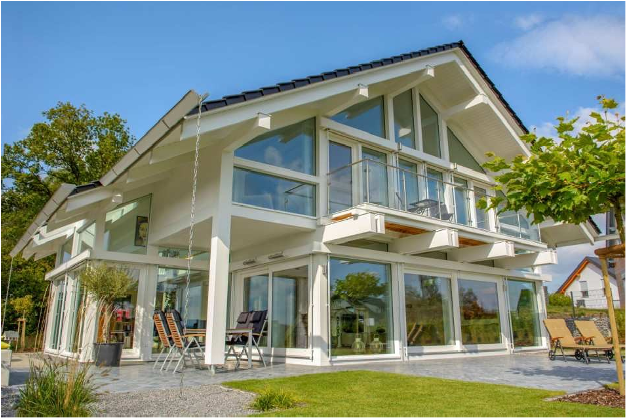
Premium German timber frame homes exemplify precision, sustainability, and architectural refinement. They unite centuries of craftsmanship with modern engineering to create efficient, long-lasting, and visually distinctive homes. Timber construction has seen a resurgence as an eco-conscious alternative to traditional building methods, with PEFC certification ensuring sustainable sourcing. Related innovations such as German glass houses and luxury German prefab homes sit within the same lineage of quality, performance, and design.
The Legacy of German Timber Architecture
- Origins of timber framing (Fachwerk) in Germany dating back to the early Middle Ages.
- Enduring examples in preserved medieval towns demonstrate long-term durability and cultural value.
- Evolution from hand-cut joinery and traditional craft to precision-driven, engineered timber systems.
- German cultural values—efficiency, sustainability, and quality—shape modern standards and design priorities established by DIN standards.
KD Haus UK exemplifies this evolution from traditional craft to engineered precision, with founder Matthew’s 35 years of architectural experience bridging historical timber frame principles with contemporary post and beam construction that enables open-plan flexibility impossible with panel-based systems.
What Defines Premium German Timber Frame Homes
- Materials and sourcing: sustainably managed, certified forests under strict German and EU forestry regulations.
- Compliance with rigorous German and European building standards for structural integrity, fire safety, and health requirements set by European insulation standards.
- Structural precision through advanced fabrication, tight tolerances, and robust quality control.
- Distinct advantages of German engineering: modular systems, repeatable accuracy, and consistent performance.
- Comparison with other regions: higher performance and consistency, stronger environmental credentials, and elevated craftsmanship.
Factory-controlled manufacturing, as employed by KD Haus UK through its German fabrication partnership, ensures precision engineering and quality assurance that closes the gap between design intent and as-built performance, particularly for critical elements like airtightness and thermal bridging.
| Key Advantage | German Premium Timber Frame | Standard Construction |
|---|---|---|
| Manufacturing Precision | CNC-controlled fabrication, ±2mm tolerances | Site-dependent accuracy, variable tolerances |
| Quality Control | Factory conditions, multi-stage inspection | Weather-dependent, limited oversight |
| Build Time | 6-12 weeks assembly | 6-18 months traditional build |
| Environmental Impact | Carbon negative, minimal waste | High embodied energy, significant waste |
KD Haus UK’s factory prefabrication with German manufacturing partnership reduces on-site construction time significantly, with shell assembly typically completing in days rather than the months required for traditional construction methods.
Design Excellence and Aesthetic Quality
- Architectural versatility enabling bespoke solutions from contemporary minimalism to refined traditional forms.
- Seamless integration of timber, glass, and steel for structural clarity, transparency, and visual lightness.
- Influence of German glass houses: daylight-optimised façades and expansive glazing that shape ambience and connection to nature.
- Energy-efficient design principles: orientation, shading, airtightness, and natural light optimisation following Passivhaus principles.
- Hallmarks of modern German style: sustainable materials, minimalist detailing, and spatial harmony.
Every KD Haus UK home is bespoke to the plot and client brief, with Matthew personally assisting with interiors, fittings and specifications to ensure architectural versatility is matched by customised design solutions that panel-based systems cannot accommodate.
The Role of Technology and Prefabrication
- Overview of advanced prefabrication: a growing share of new homes assembled from factory-built components.
- Synergy between luxury German prefab homes and high-performance timber frames for speed and quality.
- Digital modelling and computer-controlled joinery deliver precise components and predictable assembly.
- Benefits of factory production: shortened build times, reduced waste, controlled conditions, and improved environmental performance certified by BRE standards.
- Prefabrication enhances craftsmanship by ensuring design fidelity and accurate on-site assembly.
KD Haus UK operates as a single entity from architecture through handover, integrating digital modelling and precision manufacturing to eliminate the multi-party interface risks inherent in traditional procurement where separate contractors manage different aspects of the build process.
Sustainability and Environmental Impact
- Timber as a renewable, carbon-storing material central to climate-resilient construction.
- Lifelong carbon storage within timber structures and lower embodied CO2 than concrete or steel builds.
- Superior energy performance via airtight envelopes and efficient use of renewable materials.
- Overview of sustainability certifications and eco-labelling common in the German housing market supported by DGNB certification.
- Environmental benefits of resource-efficient production and long building lifespans.
Choosing a Premium German Timber Frame Home
- Selection criteria: provider certifications, design flexibility, engineering capability, and manufacturing standards.
- Cost considerations: upfront pricing balanced by durability, energy savings, and low maintenance over time.
- Planning tips: align design with site and climate, tailor aesthetics, and integrate performance targets early. Understanding how to reduce risk in self build projects is essential for successful delivery.
- Examples of acclaimed projects that showcase precision, innovation, and design excellence to guide expectations.
With turnkey delivery at approximately £3,800 per m², KD Haus UK’s defined-scope approach provides greater budget certainty than traditional procurement routes where cost overruns from trade coordination and multi-contractor interfaces are common challenges.
When selecting a premium German timber frame provider, consider their track record in the UK market, compliance with British building standards, and ability to adapt German engineering excellence to local planning requirements and climate conditions.
KD Haus UK can assist with the planning application process, integrating it into the overall project delivery rather than treating it as a separate procurement exercise, which streamlines the path from concept to completion.
The Future of German Timber and Glass Architecture
- Emerging hybrid timber systems that enhance strength, span, and design freedom.
- Growth of smart façades and energy-efficient technologies supported by ongoing innovation programmes.
- Increasing emphasis on biophilic design and healthier indoor environments.
- Rising international interest and export growth for German timber and prefab solutions.
- Stronger alignment between premium design standards and measurable environmental responsibility.
Frequently Asked Questions
What makes premium German timber frame homes different from standard timber houses?
Premium German timber frame homes feature CNC-controlled manufacturing, rigorous quality control, and compliance with strict German building standards. They offer superior precision, faster assembly, and enhanced energy performance compared to traditional timber construction.
How long do German timber frame homes typically last?
With proper maintenance, German timber frame homes can last 100+ years. Many medieval Fachwerk buildings demonstrate the longevity of timber construction when built to high standards and regularly maintained.
Are German glass houses energy efficient?
Yes, when designed with proper orientation, high-performance glazing, and thermal bridging solutions. German glass houses typically incorporate advanced insulation and airtightness measures to achieve excellent energy performance.
How sustainable are luxury German prefab homes?
They offer significant sustainability benefits through renewable materials, carbon storage, reduced construction waste, and efficient factory production. Many achieve carbon-negative status over their lifecycle.
What is the price range for premium German timber frame homes?
Costs vary significantly based on specification, size, and customisation. Premium systems typically command higher upfront investment but offer long-term value through durability, energy efficiency, and low maintenance requirements.
Can these homes be customised for different climates?
Yes, German manufacturers adapt designs for local climate conditions, building regulations, and site-specific requirements while maintaining their core engineering principles and quality standards.
Are German timber frame homes suitable for urban developments?
Absolutely. Their precision manufacturing, reduced construction time, and minimal site disruption make them particularly suitable for urban infill projects and developments with tight constraints.
How do prefabricated components affect build time and quality?
Prefabrication dramatically reduces on-site construction time while improving quality through controlled factory conditions. Weather delays are minimised, and precision is enhanced through computer-controlled manufacturing processes.
